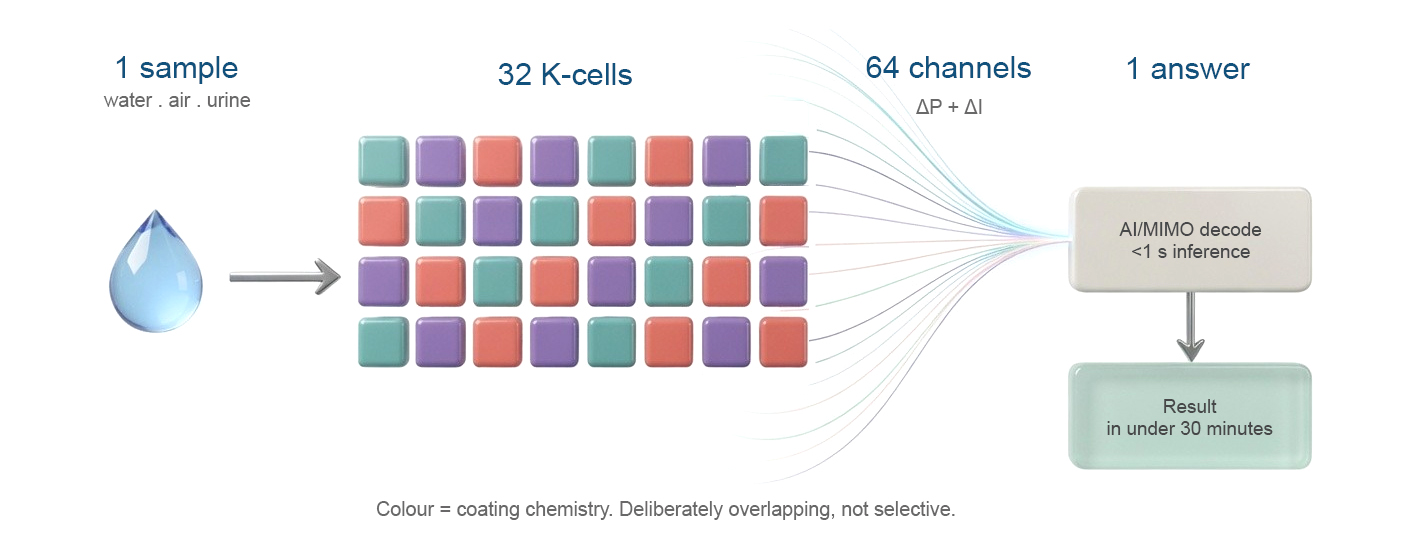
32 co-localised K-cells — each a Mach–Zehnder photonic sensor paired with a thin-film transistor —
functionalised with cross-responsive organic semiconductors to emulate mammalian olfaction.
How it works
From sample to actionable result
A single, synchronous pipeline turns a raw sample into an actionable result.
Technology pillars
Five pillars of the platform
MZI photonics
Optical transduction
Evanescent-field-enhanced Mach–Zehnder interferometers detect minute refractive-index changes as
analytes bind to the coatings. Thermo-optic multiplexing lets a single Ge-on-Si photodiode read
the whole array, keeping the optical engine compact and low-power.
TFT electronics
Electrical transduction
Co-localised thin-film transistors measure the change in drain–source current (ΔIDS)
from the same coating. This second, orthogonal readout multiplies selectivity — two independent
views of every interaction, captured at the exact same spot.
ESJET coatings
Functionalisation
Electrostatic jet (ESJET) printing at < 10 µm print resolution deposits more than 20 partially overlapping organic
semiconductor coatings across a 32-cell array in under 15 minutes. The cross-responsive library
is what gives the platform its rich, high-dimensional chemical fingerprints.
Microfluidics
Sample handling
Pump-free EWOD (electrowetting-on-dielectric) microfluidics deliver the sample to the array
without bulky peripherals, targeting a disposable cost of ≤ €10 (≤ €5 at scale) — essential for field and point-of-care use.
The SafeDrop compact, pump-free microfluidic system, based on FBK's advanced Electrowetting-on-Dielectric (EWOD) technology, addresses the project targets for portable, cost-effective alternatives to traditional testing equipment. Traditional microfluidics rely on complex, rigid networks of pumps and channels that limit flexibility and field use. SafeDrop replaces these bulky components with a low-power, highly scalable droplet-management system. By applying precise electrical signals to an electrode array, the platform dynamically modulates droplet contact angles, routing liquid samples across integrated sensors with high accuracy.
By merging low-power operation with simple manufacturing, the SafeDrop microfluidic module delivers a versatile, highly integrated solution designed to meet the strict demands of next-generation diagnostic and environmental monitoring tools.
The key advantages for the SafeDrop project are:
Enhanced portability: eliminates mechanical micropumps for a lightweight, compact integrated system
On-site detection: sample management to analyse multiple contaminants, biomarkers, and metabolites on site
Flexible and scalable: reconfigurable droplet routing tailored to diverse testing needs
AI / MIMO analytics
Decision layer
Multiple-input, multiple-output (MIMO) machine-learning models fuse the optical and electrical
channels to classify targets. The project targets >99% classification accuracy, >95%
false-positive reduction and <1 s latency.
Educational resources
Why multimodal sensing?
A single sensor channel is rarely selective enough for complex mixtures in the field. SafeDrop
takes inspiration from mammalian olfaction: many partially selective receptors, read in
parallel, produce a high-dimensional fingerprint that machine learning can decode.
By capturing both optical (ΔP) and electrical (ΔIDS) responses from the same coating,
each K-cell offers two orthogonal views — multiplying information without multiplying hardware
at the sampling point.
Explainer video
Coming soon — how SafeDrop works in 3 minutes
Frequently asked questions
Understanding SafeDrop
A K-cell is a co-localised sensing unit combining a Mach–Zehnder interferometer (optical channel) and a thin-film transistor (electrical channel) on the same spot, functionalised with a cross-responsive organic-semiconductor coating.
Like a dog's nose, SafeDrop uses an array of imperfect but complementary sensors. No single channel identifies everything — instead, the combined fingerprint is decoded by AI to recognise targets in complex environments.
Technology Readiness Level (TRL) measures maturity from 1 (basic research) to 9 (proven in operation). SafeDrop starts at TRL 3. The application demonstrators target TRL 5 (TRL 4 for air quality), while the underlying photonic techniques are matured to TRL 7.
Laboratory methods are accurate but slow and centralised. SafeDrop targets laboratory-grade selectivity in a compact, field-deployable format — delivering results in minutes at the point of need, with a low-cost disposable cartridge.
SafeDrop will release open process design kits (PDKs), open hardware references and standards contributions to help researchers and innovators build on the platform beyond the project lifetime.
Platform at a glance
Design targets guiding development from proof-of-concept to demonstrator